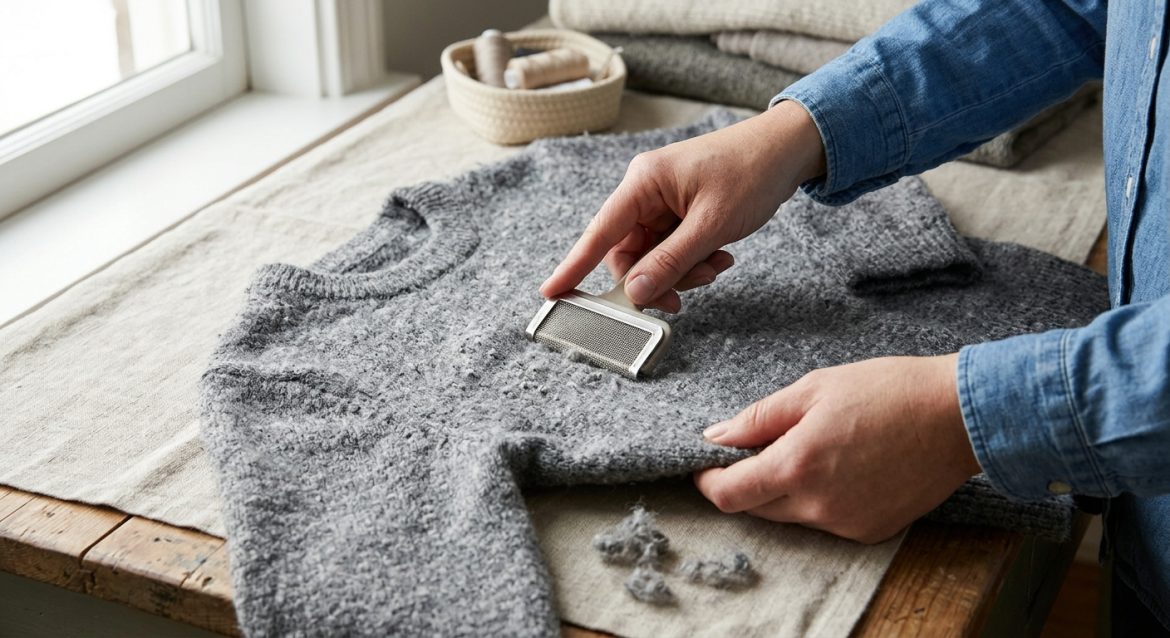
Removing sweater pills safely comes down to matching your tool's friction level to your sweater's yarn strength while holding the knit completely flat under light tension. Fine cashmere and superfine merino require low-friction manual tools like a wire-mesh sweater comb, whereas heavy natural wools handle abrasive sweater stones and synthetic blends require guarded rotary blades. Dragging an unguarded disposable razor across a sweater or pulling pills off by hand snaps intact fibers, stretching the knit and accelerating pilling down the line.
Tool Selection by Fiber and Knit Gauge
Pilling occurs when short textile fibers break, tangle, and curl into tight balls under surface friction. Because natural animal hair, cotton, and synthetic yarns handle abrasion differently, using one depilling tool across your entire closet risks tearing delicate knits or leaving tough synthetic pills behind.
- Fine-gauge natural knits (Cashmere, superfine merino, silk-wool blends): Use a fine-mesh sweater comb. The fine screen catches fuzzy surface knots without pressing sharp edges or heavy grit into fragile yarns.
- Medium to heavy natural knits (Lambswool, Shetland wool, heavy cotton): Use a pumice sweater stone or a coarse sweater comb. Volcanic pumice grabs rigid wool fibers, snapping tangled pills cleanly away while leaving the core knit structure untouched.
- Synthetic and blend knits (Acrylic, polyester, nylon blends): Use an electric fabric shaver featuring an adjustable height guard. Synthetic fibers are far stronger than natural wool, making manual pulling difficult. Spinning internal blades shear through tough synthetic tangles without dragging the underlying fabric.
- Tools to avoid on all fabrics: Standard disposable safety razors lack distance guards, making it easy to cut raised knit loops and create instant holes. Plucking pills with your fingers pulls hidden internal fibers up to the surface, creating a fresh layer of fuzz that turns into new pills within a few wears.
Workspace Preparation and Fabric Tension
Before touching any tool to your garment, set up a working space that eliminates loose fabric movement and uneven pressure points.
- Work on a hard, flat surface: Spread the sweater out on a clean wooden table, desk, or ironing board. Depilling garments over soft surfaces like beds or lap cushions allows the fabric to yield under pressure, causing shaver guards or comb edges to catch on loose loops.
- Smooth out folds and wrinkles: Flatten the sweater outward from the center seam. Any folded edge or wrinkle forms a raised ridge that acts as a target for blades or abrasive surfaces.
- Anchor the sweater under gentle tension: Place your non-dominant hand flat against the garment near the work area, pulling the fabric taut without distorting the knit pattern or stretching the ribbing. Light tension keeps the surface flat so the tool only makes contact with raised pills.
- Inspect under direct lighting: Position a lamp directly over your workspace so you can easily distinguish between raised pills and structural knit loops before making a pass.
Step-by-Step Depilling Techniques
Using a Fine Sweater Comb
- Lay the sweater flat and anchor the fabric with your free hand.
- Hold the comb at a 45-degree angle relative to the garment surface.
- Glide the comb downward in short, single-direction strokes following the vertical grain of the knit.
- Use light, consistent pressure. Allow the wire screen to catch loose fuzz naturally rather than pushing the frame down into the fabric.
- Lift the comb after every few strokes and pull accumulated fuzz from the mesh before continuing.
Using an Electric Fabric Shaver
- Attach the height guard and set it to its highest position for textured or lofty knits, or a medium setting for flat, smooth knits. Never use an electric shaver on fine wools without a height guard attached.
- Turn the unit on and place the metal foil guard flush against the taut fabric.
- Move the shaver head across pilled areas using light, continuous circular motions.
- Avoid pushing down into the fabric. Excessive downward force pushes soft knit loops through the foil holes into the spinning blades, cutting holes into your sweater.
- Pause frequently to empty the lint reservoir so the internal motor maintains full speed and suction.
Using a Pumice Sweater Stone
- Hold the pumice stone firmly along its widest edge.
- Drag the stone gently across medium or heavy wool garments in one continuous direction.
- Let the porous texture of the stone grip and break off coarse surface pills.
- Use a soft clothes brush or a sticky lint roller to sweep away pumice dust and detached lint from the sweater when complete.
Diagnostic Checklist: Identifying Fabric Stress Early
Monitor the garment closely while working. If you notice any of the following warning signs, stop depilling immediately and adjust your approach:
- Thinned or sheer areas: Light passes through a specific patch more easily than surrounding fabric. This indicates that your tool depth or friction is wearing down primary yarn strands alongside surface pills. Switch to a gentler tool or increase guard distance.
- Raised thread loops (snags): An intact strand of yarn extends above the sweater surface. Your tool has snagged structural thread rather than loose surface fuzz.
- Post-care micro-fuzz: A haze of fine fuzz appears immediately after a pass. This indicates that your tool blade is dull or the comb tooth is tearing fibers instead of severing them cleanly.
- Yarn dust accumulation: Significant piles of fine fiber dust on your table mean the tool is abrading healthy yarn.
To repair a raised thread loop without damaging the knit, do not cut the loop with scissors. Insert a dull yarn needle or latch hook from the inside of the garment directly under the snag, hook the loose loop, and pull it through to the reverse side of the sweater.
Washing Routines to Prevent Future Friction
Depilling clears existing surface knots, but modifying your laundering routine prevents new pills from forming.
- Wash sweaters inside out: Turning garments inside out forces drum friction and mechanical agitation onto the interior face of the fabric, protecting the visible exterior surface.
- Switch to liquid detergents for delicate fabrics: Powdered detergents can fail to dissolve completely in cold water, leaving micro-granules that act like fine sandpaper against soft yarns during agitation. Liquid wool formulas lubricate fibers to minimize friction.
- Use mesh wash bags: Place each sweater inside an individual zip-up mesh laundry bag before washing. This keeps sleeves and body panels from twisting around other garments or rubbing against zippers, buttons, and crisp cotton fabrics.
- Run gentle cycles with cold water: High spin speeds and warm water stretch natural fibers, breaking individual filaments that quickly curl into pills. Use gentle or hand-wash settings with short spin cycles.
- Dry flat on a clean towel: Heat from clothes dryers weakens yarn elasticity and breaks down fiber ends. Reshape damp sweaters by hand and lay them flat on a dry towel away from direct heat and sunlight.
Choosing Your Starting Point
For high-value cashmere, extra-fine merino wool, or silk-wool blends, begin with a fine-mesh sweater comb. Test your technique on an unexposed interior hem before moving to high-friction areas like the underarms, cuffs, and side seams. For heavy acrylic cardigans, synthetic fleece, or dense Shetland wools, use an electric fabric shaver with a multi-height guard to process broad surfaces safely and efficiently.